
Thirteen agents, working as a coaching staff
A human coach does three things a static plan cannot: plans a season around your races, adjusts day by day to how you actually are, and reviews the week and course-corrects. Aegis reproduces all three with a pipeline of specialised agents, each with a narrow job, its own instructions and the right size of model for the task.
Thirteen agents, five jobs
Generation is hierarchical: season, blocks, weeks, workouts, recovery protocols. Each agent has a single responsibility, an isolated prompt and its own model tier, and each one's output becomes the next one's input. Premium reasoning models do the strategic thinking a handful of times a season. Fast models do the routine work thousands of times a day.
Plan the season
Premium tier, deep reasoningBuild each week
Fast tier, structured outputAdapt every day
The micro-adaptation loopReview every week
The macro-adaptation loopAnalyse the work
From the device fileContext matched to altitude
Strategic agents receive the full athlete picture and every coaching lever. Daily agents receive only what today needs. No agent is sent a generic blob.
Sport-routed coaching personas
Strategic decisions are made by the right specialist: running, cycling, swimming, multisport, ultra or general fitness, chosen from the athlete's sport and next A-race.
Durable by design
Every long-running AI job runs as a background task with idempotency locks and progress tracking, so a dropped connection never leaves a half-built plan.
A rolling window, not a fixed document
The season is periodised into blocks. The athlete always sees about four weeks ahead: two built session by session, two sketched in outline. Each weekly review builds out the nearest outline week using everything learned since it was first drafted.
Sport-specific coaches
A runner is coached by a running supervisor, a cyclist by a cycling one, an ultra-runner by an ultra specialist and a triathlete by a multisport coach, each with its own caps and progression rules.
Periodised strength
Strength follows the block: muscular endurance in base, max strength in build, power at peak, maintenance near a race. Tailored to what each sport demands.
Targets that move with fitness
Update an FTP, threshold pace or swim CSS and every upcoming session re-scales within seconds. Blocks are also weighted towards the disciplines the athlete rates as weakest.
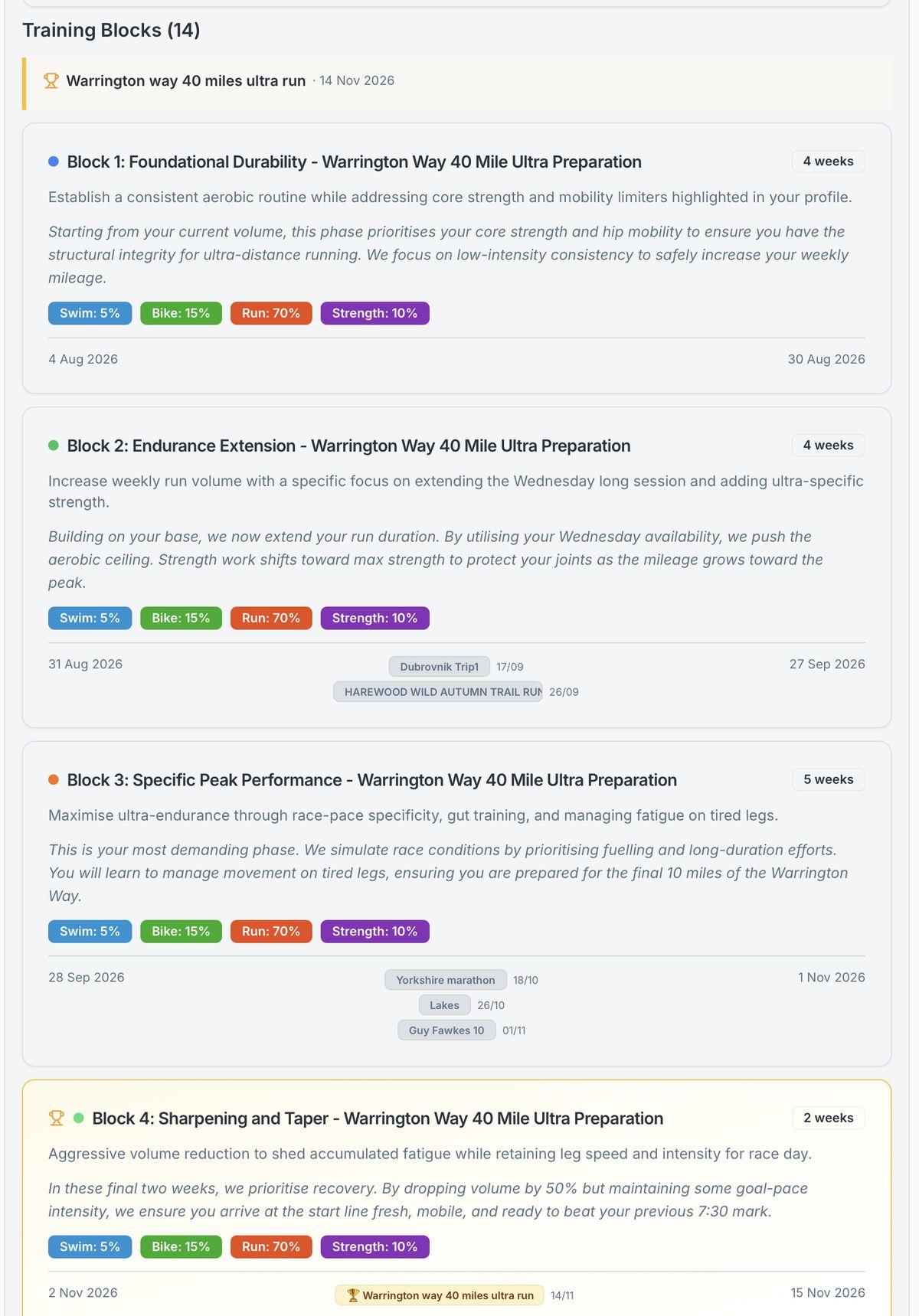
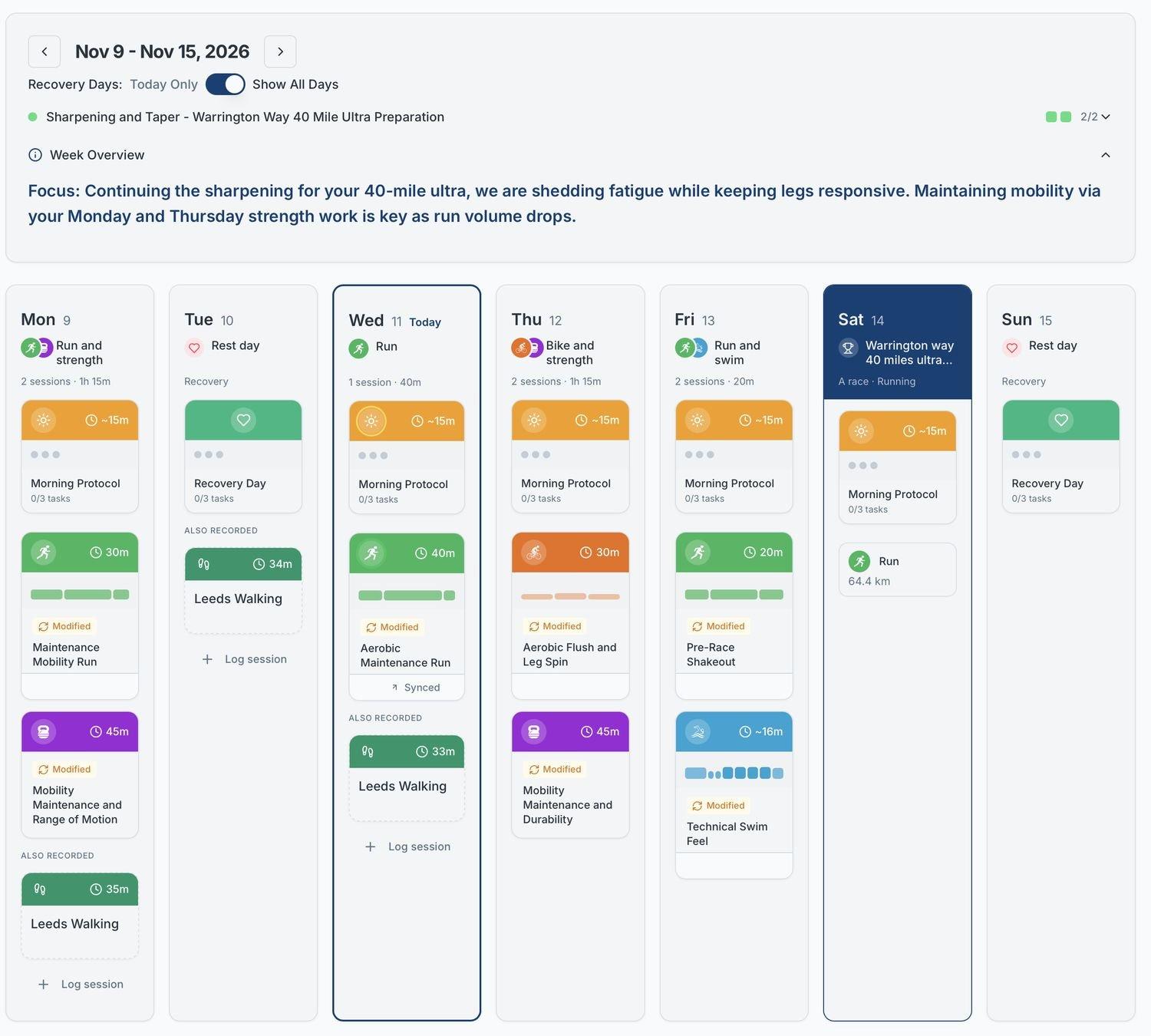
Screens from the founder's own live plan, the week of a 40-mile ultra. Select any image to enlarge it.
How Aegis decides what each block works on
A rules engine finds each athlete's limiter and tells the planning agent which discipline leads each block.
The comparison table, the four rules and a worked example are in the platform detail.
Request accessTwo feedback loops
Decisions run on device data first, with the athlete's own read layered on top. Pain, niggles or illness mentioned anywhere are always treated as a protection signal.
Every morning: the daily loop
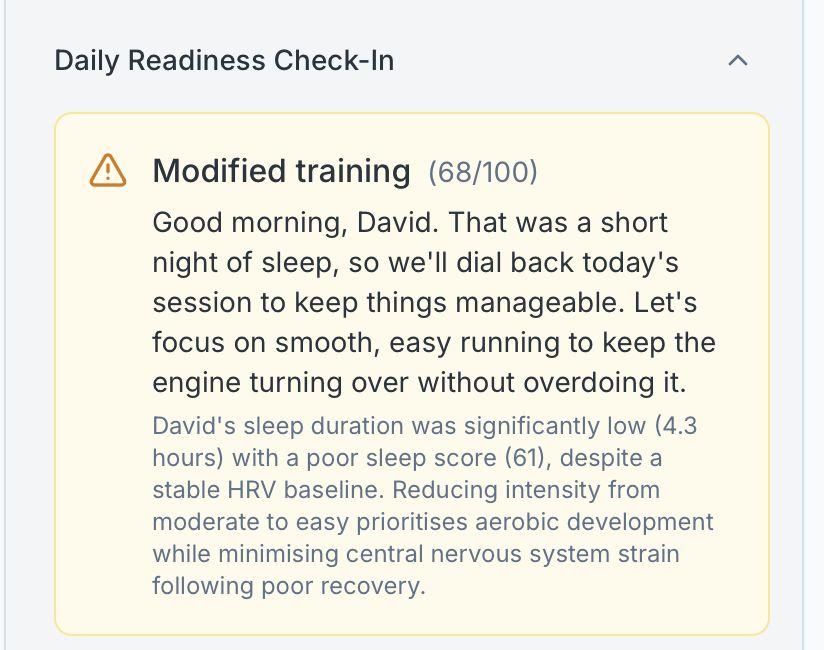
The athlete's wearable pre-fills a check-in that takes seconds. If they are not ready for a hard day, the session is rewritten on the spot. A readiness score is computed first, and the AI can override it when the device data tells a different story. If the AI is briefly unavailable, the check-in is saved and retried in the background.
Every week: the weekly loop
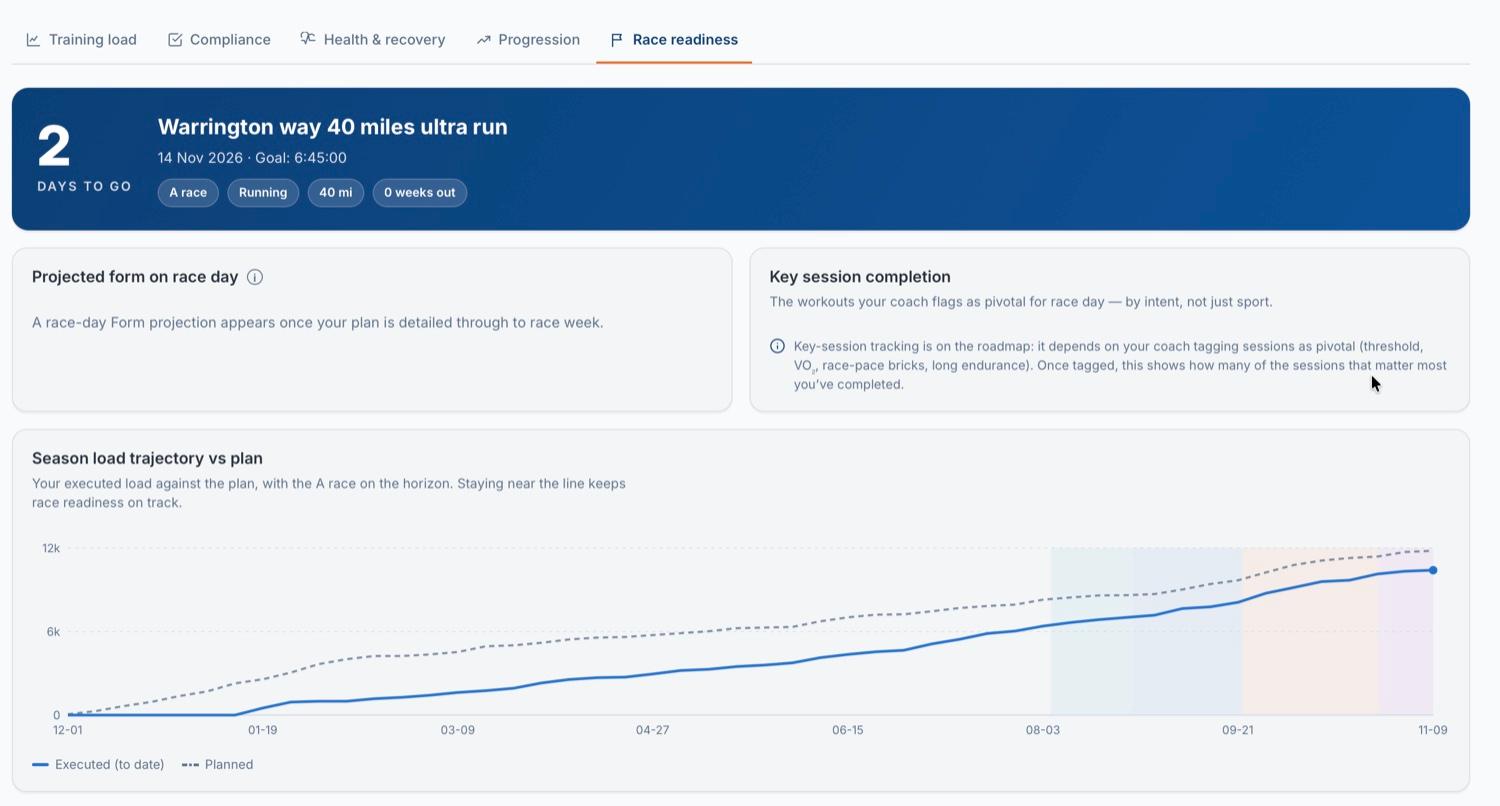
Planned load is compared with load measured from actual device files using the Aegis Hybrid Training Load metric. The plan moves in both directions. The AI proposes how far a change should reach, and deterministic severity rules clamp it.
Earned progression
A harder week is only prescribed when training has felt easy two check-ins running with clean readiness. Any step up is capped at ten per cent, one week at a time.
Adaptation that scales
A one-off dip eases the coming week. Three amber mornings reshape both detailed weeks. Five, or any mention of injury, re-plans the whole horizon.
The athlete has a say
Experienced athletes accept or decline a suggested change, and the plan rolls forward either way. Newer athletes are guided, and can challenge a decision once.
The coaching levers
Coaching judgement lives in thirteen coach-authored lever groups that bound every strategic AI call.
The table of house defaults is in the platform detail.
Request accessDevices, scoring and analytics
Aegis works without any device. A connected one removes the admin and sharpens every decision. Three wearable integrations are built, covering sports watches, bike computers and recovery rings, and every session can be exported as a .fit or .zwo file.
Workouts out
Run, bike and swim sessions pushed to the athlete's device as structured workouts, step by step.
Activities back
Finished sessions arrive by webhook, are matched to the plan, completed and analysed automatically.
Overnight health
Sleep, heart-rate variability, resting heart rate and stress, read against the athlete's own 7-day baselines.
Bike computers
A third integration for head-unit riders: bike sessions out, rides back.
Smart trainers: .ZWO
Any bike session exports as a .zwo file with power and cadence targets, ready for ERG mode on a smart trainer. Run sessions export for the treadmill with pace targets.
Any device: .FIT
Bike, run and swim sessions export as .fit workout files, and completed .fit files can be uploaded for analysis from any device.
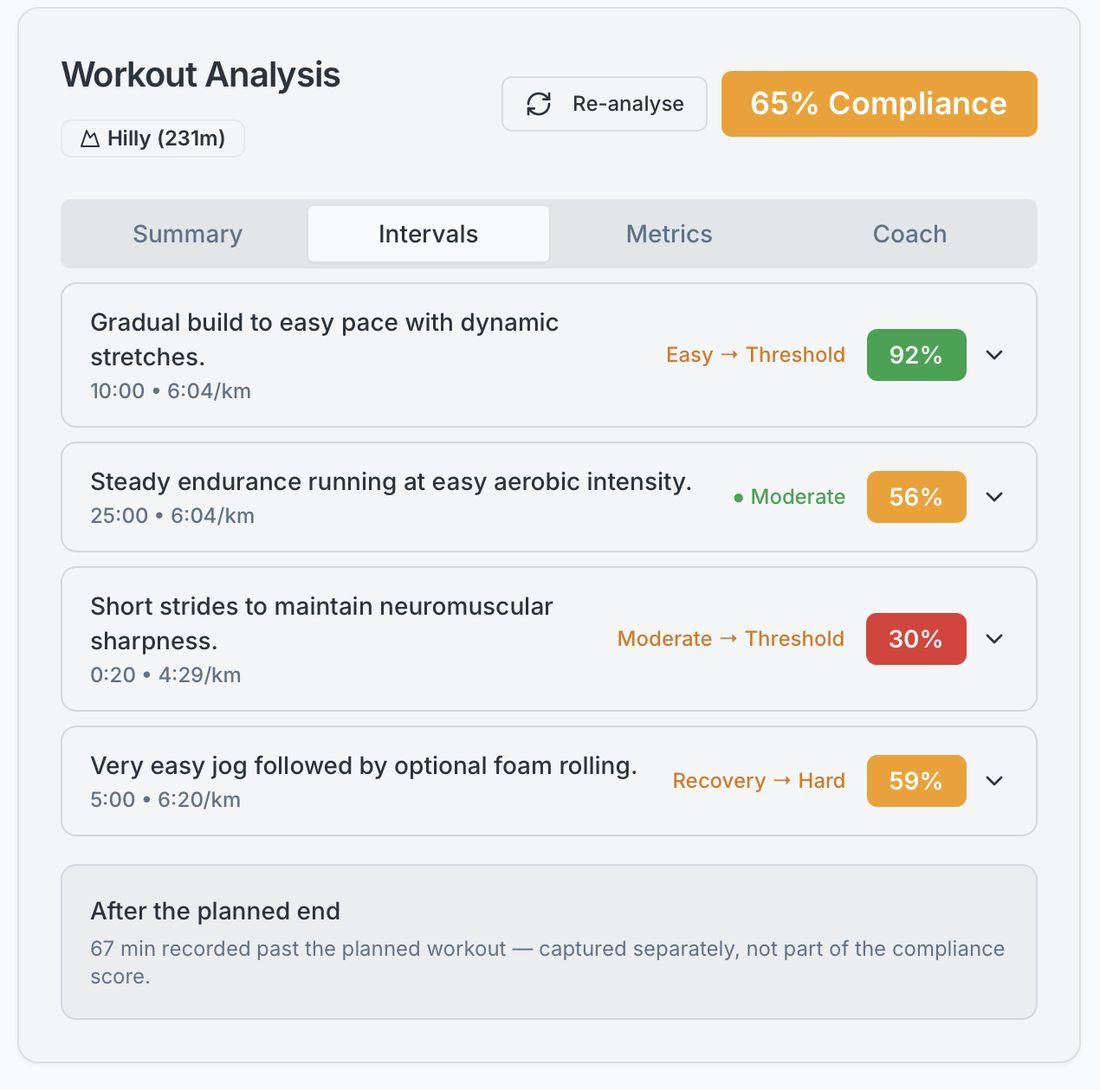
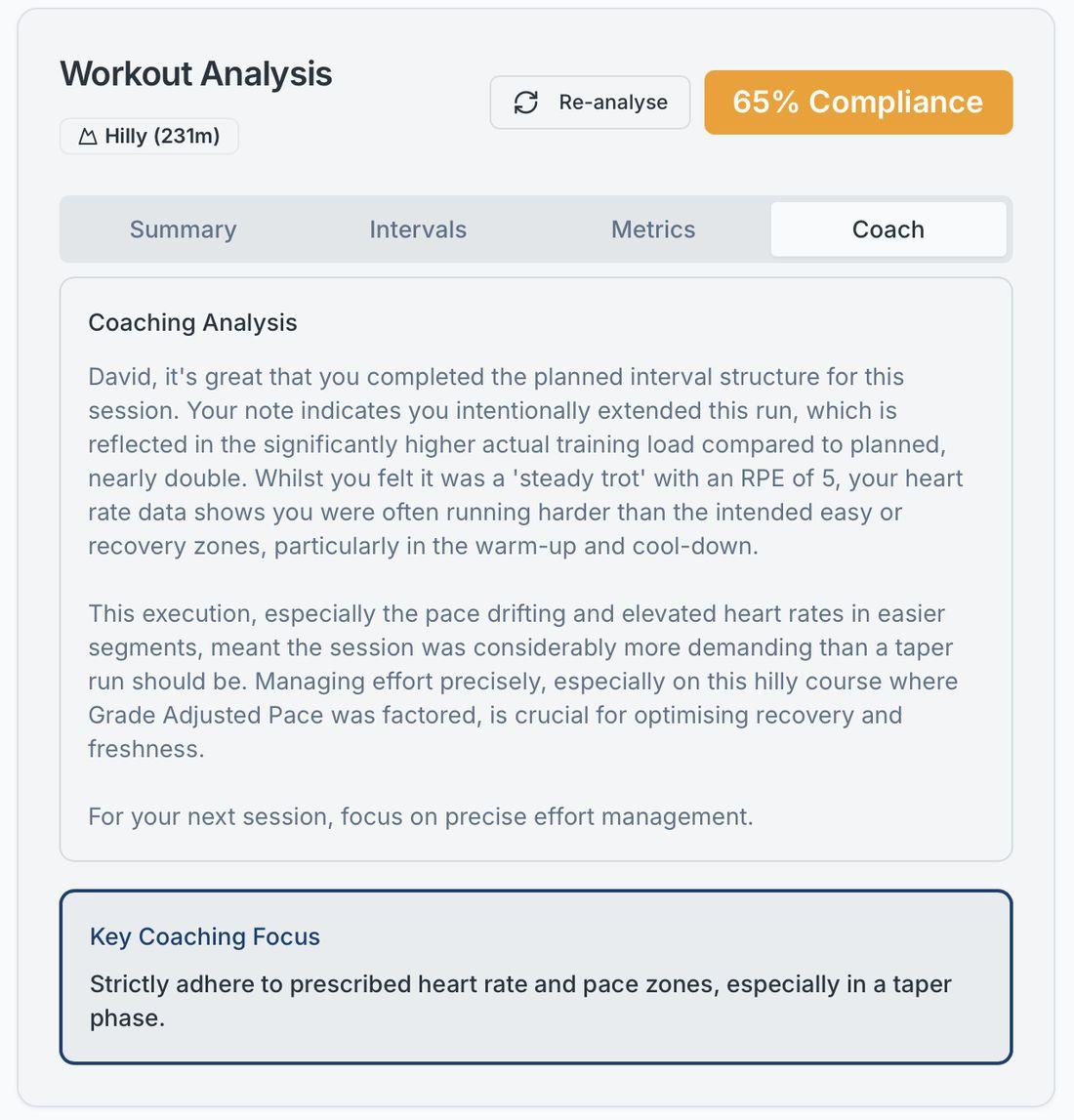
Compliance scoring like a coach
The engine ignores lap markers and finds the hard efforts in the trace itself. Each interval is scored on an asymmetric curve, because overcooking a recovery is a different miss from easing off an effort.
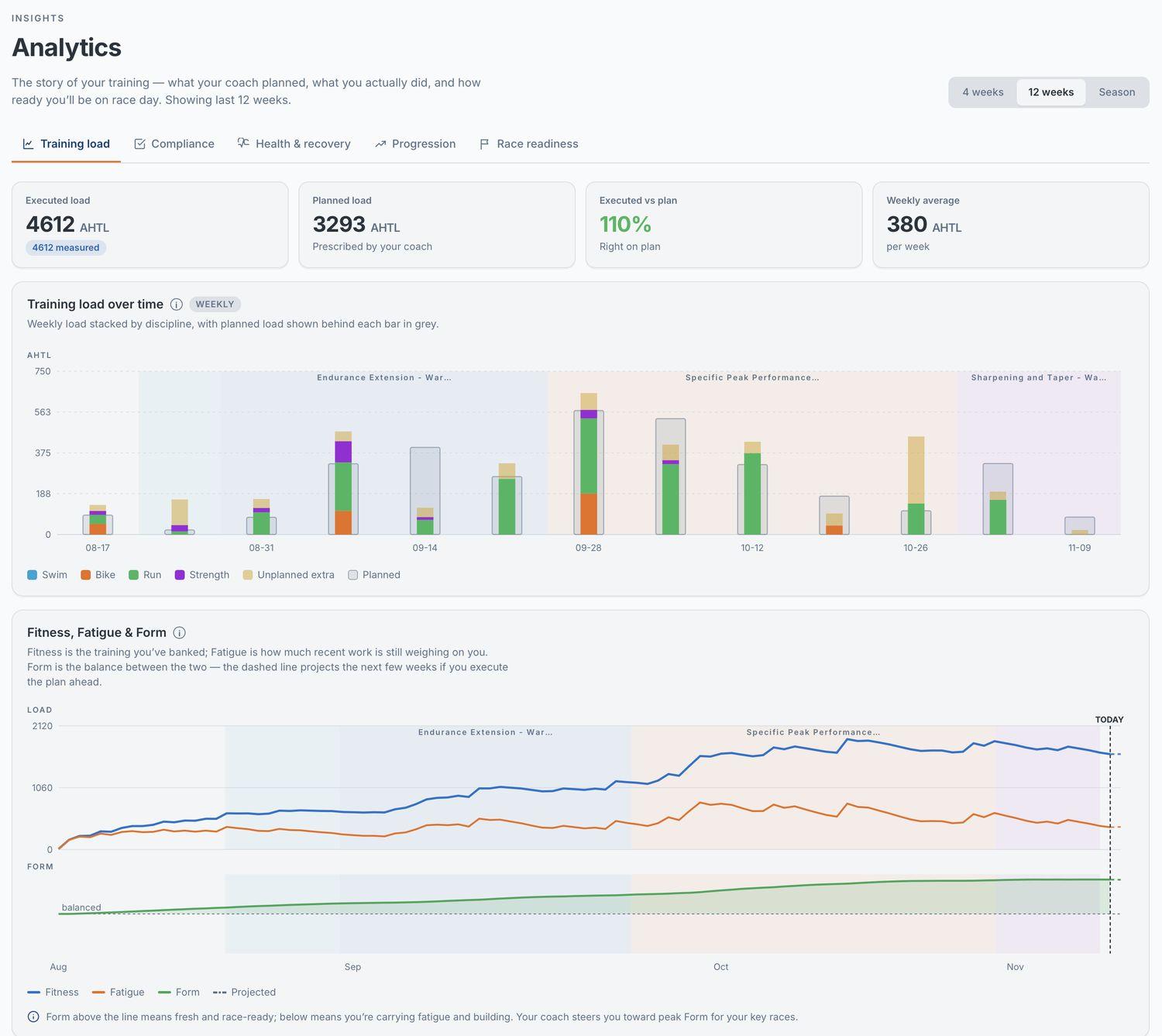
Fitness, fatigue and form
Athlete analytics run the published Banister impulse-response model over daily training load, with grade-adjusted pace, weighted power and heart-rate decoupling in the workout analysis.
Everything counts
Unplanned rides, a parkrun, a manually logged session: all of it feeds training load. Sessions logged by feel are marked as estimates, never blended in silently.
Why this is safe to scale
Every AI call runs through one provider-agnostic gateway with schema-enforced output, cascading fallbacks and a full audit trail.
The design and the observed per-action costs are in the platform detail.
Request accessThree things on the roadmap
Athlete memory, a reusable workout library and a tier for athletes who coach themselves, each building on the live engine.
The designs are in the platform detail.
Request access